Breadth or Depth? Choosing Between the IB Diploma and A-Levels
Hawkeye Education · 2026-07-29 · 4 min read
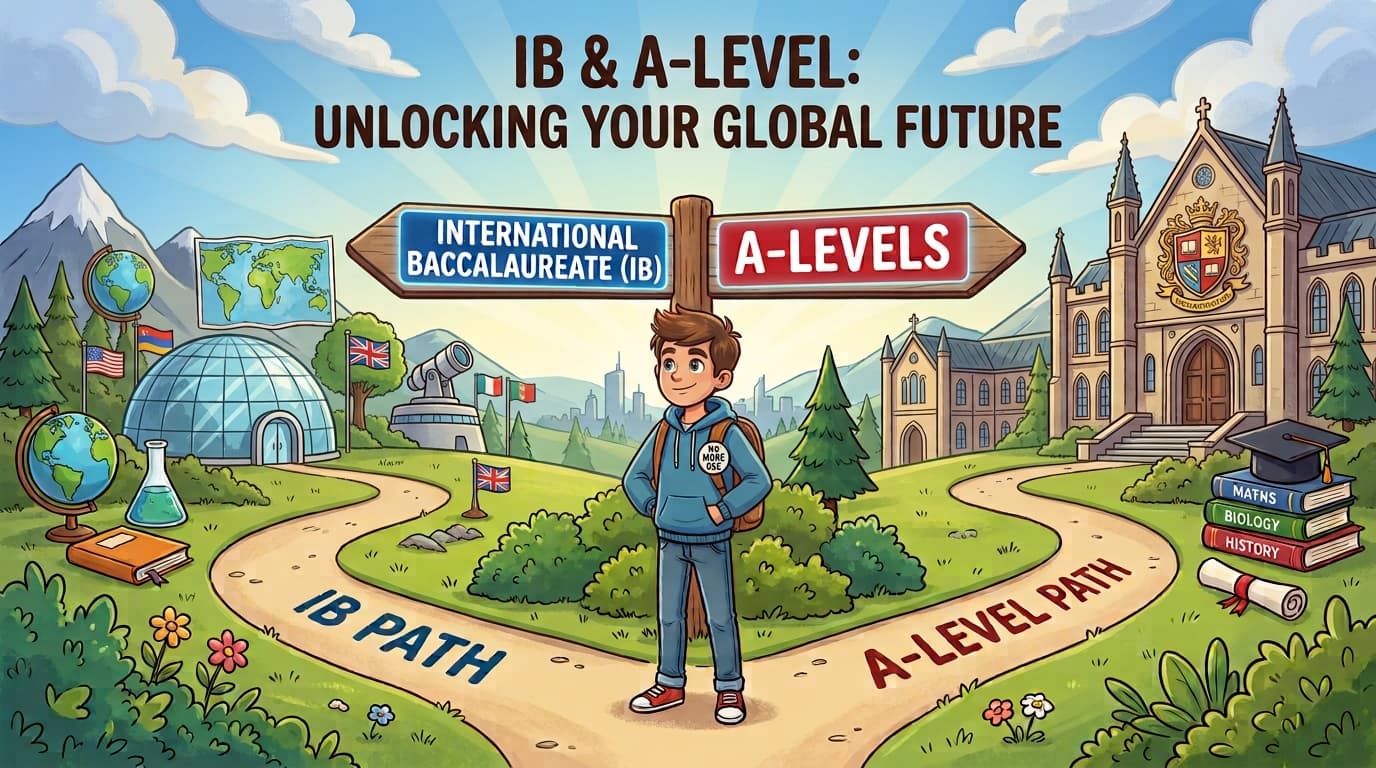
Choosing between the International Baccalaureate (IB) Diploma Programme and A-Levels is rarely about deciding which qualification is “better” or more prestigious. Both are rigorous, internationally respected pre-university pathways. The better choice depends on a student’s academic goals, learning style, strengths, and preferred way of working.
The essential difference is breadth versus depth: the IB develops well-rounded, multidisciplinary learners, while A-Levels allow students to specialise deeply in a smaller number of subjects.
The IB Student Profile: The Versatile Generalist
The IB Diploma is a broad, structured programme. Students normally take six subjects across languages, humanities, sciences, and mathematics, together with three core components: the Extended Essay (EE), Theory of Knowledge (TOK), and Creativity, Activity, Service (CAS).
Who Should Choose the IB?
The Undecided Explorer: If you are 16 and still genuinely unsure whether you want to pursue medicine, history, international relations, or data science, the IB keeps a wide range of options open. You do not have to abandon the humanities for science, or vice versa.
The Strong Time Manager: The IB requires students to balance six subjects with Internal Assessments (IAs), laboratory reports, reflection logs, and a 4,000-word Extended Essay. Students who work well with structured calendars, multiple deadlines, and steady progress are likely to thrive.
The Well-Rounded High Achiever: If you perform consistently well across different subjects—from English literature to chemistry—the IB allows you to make full use of that balanced academic strength.
The US-Focused Applicant: US universities often value academic breadth, sustained course rigour, critical thinking, and meaningful extracurricular involvement. The IB’s CAS and TOK components fit naturally with this holistic approach to admissions.
The A-Level Student Profile: The Focused Specialist
A-Levels allow students to concentrate on three or four subjects of their choice. There are no compulsory core projects or required subject-group distributions, so students can specialise more fully in the areas most relevant to their future plans.
Who Should Choose A-Levels?
The Clear-Path Specialist: If you have known from an early age that you want to become, for example, an aeronautical engineer, you can choose Physics, Chemistry, Mathematics, and Further Mathematics while dropping unrelated subjects such as essay-based humanities or foreign languages.
The Asymmetric Learner: If you excel in STEM but struggle with extended essay writing—or if you are an outstanding historian who finds algebra difficult—A-Levels let you avoid weaker areas and focus on subjects in which you can achieve top grades.
The Deep Diver: A-Level syllabuses often explore individual subjects in greater depth than broad pre-university programmes. Students who want to spend two years studying literature intensively or analysing advanced mechanics without competing subject demands may prefer this route.
The High-Stakes Exam Performer: Because A-Levels are generally more dependent on final examinations and less dependent on continuous coursework and compulsory core requirements, they suit students who prefer focused revision and perform strongly under exam conditions.
Head-to-Head Comparison
Feature
International Baccalaureate (IB)
A-Levels
Structure
Six subjects, usually three Higher Level and three Standard Level, plus the core
Three or four subjects chosen by the student
Educational approach
Broad, global, and interdisciplinary learning
Focused mastery and subject specialisation
Assessment
A combination of examinations, coursework, IAs, and the EE/TOK core
More exam-heavy, with assessment centred mainly on final examinations
Workload pattern
Continuous and steady pressure across two years
More concentrated revision before major examination periods
Typical fit
Students targeting broad or multidisciplinary degrees, including many US university pathways
Students targeting highly specialised degrees or direct subject-specific entry, especially in the UK
How to Make Your Final Decision
To decide which pathway suits you best, consider these four practical factors:
Weak subjects: Can you afford a lower grade in a compulsory subject? In the IB, weaker performance in a required subject can reduce your total score. In A-Levels, you can usually avoid subjects that do not suit your strengths.
University target: UK universities often make conditional offers based on specific subject combinations and grades, which can make A-Levels a very direct route. US universities often place more emphasis on academic breadth and the wider school profile, which can make the IB a strong fit.
Working style: Do you prefer managing several overlapping deadlines throughout the year, or concentrating your effort on mastering content for major examination periods?
Extracurricular integration: Would you like your extracurricular activities to form part of the diploma through IB CAS, or would you prefer to keep them separate from your academic qualification?
Summary
The IB is generally better suited to versatile students who value breadth, balance, and continuous assessment. A-Levels are generally better suited to focused students who value depth, subject choice, and examination-based assessment.
The best decision is the pathway that aligns most closely with the student’s strengths, working habits, intended degree, and target universities.